Some days, when I arrive in New York’s Grand Central Station, I partake in a ritual.
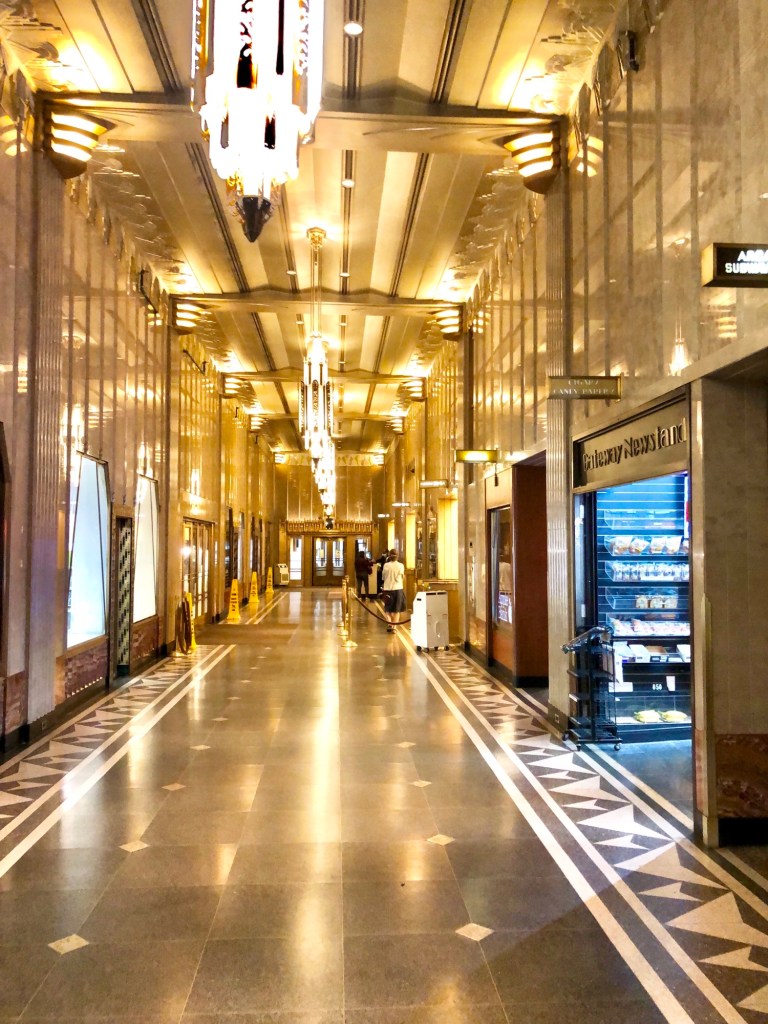
Crossing 42nd, I carefully dodge the urgency of yellow cabs and harried commuters and proceed to the Southeast corner of the street. I enter the gilded, art deco lobby of the Chanin Building, site of my very first job.
It never lets me down.
If I am lucky and it is after rush hour, there are few people around. If I am very lucky, it is only me. Working quickly, I discreetly raise my phone and snap a photo of the golden lobby. A few times prior I was disciplined by an eagle eyed security guard who growled, “No pictures…!” It is a different world now. But this time, I prevail.
I will send the photograph to my old co-worker Irene, who worked with me in our small office in the Chanin Building for over twelve years. I have not seen her, in over forty. Besides me, Irene is the last surviving member of our posse. Over the years, I have sent Irene several photos of the Chanin Building lobby, the most recent one with my older son standing at my side. No written message is ever needed. The photo alone is my way of saying I am thinking of her.
I proceed past the newsstand where I used to meet my after-work dates. “ Let’s meet at the Candy stand!” And never fail, at 5:30pm sharp, Irene and her counterpart Barbara would stroll discreetly and nonchalantly past so the next morning they could give me a nod (or not) of approval in regard to a potential new suitor.
They always looked out for me.
I head toward the elevator bank which leads to my old office on the 12th floor. The elevator doors etched elaborately in gold figurines are a thing of beauty. I consider going up to my old floor, then decide against it.
I exit the lobby of the grand Chanin Building on the corner of 42nd Street and Lexington Avenue, leaving behind ghosts of a benevolent past. All in all my visit takes less than five minutes, but that is all I need. My feelings are elated and I am ready to return to present day once again as I head downtown to meet my sister for dinner.
Some find the past can be melancholy, those bygone days of younger years. But standing in the lobby of the Chanin building, it is the good times I remember. So many, they are impossible to count and I am forever grateful to those cherished people who contributed to my happiness.
I love visiting this building of my past and a shout out to my days as a “working girl.”Though I think I will take a break before visiting again.
“For whoso hath too much of any good, Of that same good he shall be soon bereft.”
John Lydgate, 1430, The Fall of Princes.
Discover more from Shangri-La
Subscribe to get the latest posts sent to your email.


Beautiful, happy memories, shared with a lifelong friend. What a great story to share!
LikeLiked by 2 people
Thank you Sharon!
LikeLiked by 1 person
Kathy – it’s the photograph with no message that stays with me. You let the place say it for you, and Irene understands perfectly. I spend my days on old streets and old photographs, and I’ve come to trust a place to carry a feeling better than a paragraph can.
In case it’s any use: the Chanin Building as it looked brand new, 1929, is public domain (Mid-Week Pictorial, via the Internet Archive) – https://commons.wikimedia.org/wiki/File:Chanin_Building_1929.jpg – maybe something to set next to your lobby photos, so Irene can see the building young too.
Did the lobby feel any different back then, or is the gilding the same as it was in your office days?
LikeLiked by 1 person
Wow Mikey. Thank you for that old photo and for understanding exactly that my photo to Irene, needed no words. The lobby stands exactly the same. The newsstand/candy stand where I met my dates looks different. There was a $19.99 and under dress store in the corner of the lobby that is no longer. You may enjoy its history in this story https://nynkblog.com/2022/08/27/you-get-what-you-pay-for/.
LikeLike
Kathy, thank you. The elevator, the cobalt blue dress, and the feeling being the point. That last part is the whole story. What gets me is that the building held but the newsstand and the $19.99 store didn’t. Those little rooms inside big rooms are what I chase: gone now, still real in how somebody remembers them. I spend my days finding what stands in those spots today and saying plainly when nothing does. If you ever want a look at what’s left of that lobby corner, say the word. No pitch, no rush. Just glad you wrote it down.
LikeLike
Yes!
LikeLike
Went and looked. The cameras stop at the door: the closest any lens gets to that address is the ground-floor store, and above it an office. No newsstand, no dress rack, and the lobby itself was never caught from the street. So that corner lives the way you wrote it down, which might be the right place for it. Glad you said yes.
LikeLike
How wonderful that entering a lobby brings back so many happy memories. Thanks for sharing your great story. Maggie
LikeLiked by 2 people
Thx Maggie🌝
LikeLiked by 2 people
It’s amazing how what happens along the way is what matters, isn’t it?
LikeLiked by 1 person
Indeed it is Ted. Thx for reading
LikeLiked by 1 person
Reading is one of the things we can do for one another-if my reading helps keep you writing your wonderful vignettes then I’m doing my job!😝💪
LikeLiked by 1 person
Thank you Ted, you keep reading and I’ll keep writing! New one coming Monday :))))
LikeLiked by 1 person
It is nice that you have a place that holds such nice memories. That is a gift!
LikeLiked by 1 person
Thank you Diana.I agree!
LikeLiked by 1 person
After working in Asia for thirty years, I returned home to take up a final assignment reengineering a hospital and naturally looked forward to returning to the country town one thousand klms to the north where I grew up. In my mind I could see it as it was as a child when I was free to roam around and discover without a care in the world. But on my return to the town on vacation It had moved on and landmarks once familiar as I checked out the town on my bicycle were no longer there replaced by modern shops and unfamiliar roads. The town had moved on and the bubble that had sustained me as I wandered the jungles of Asia thinking of home return was popped. It was time to move on.
LikeLiked by 1 person
Ian, I kept wishing, hoping you would say you found some outlier,some small remaining memory of your past when you returned to your hometown amid the many changes. It was unfortunate that not even one landmark remained.
LikeLiked by 1 person
Ian, the bubble and the ground. Nobody warns you that the map in your head doesn’t update with the town. Do you mind saying which one it was? I spend a lot of time looking at what’s still standing in places people lost, and I’m curious what that street holds now.
LikeLike
That is so true. Our minds do relish the happy memories of the past and to return after 30 years and expect things to be the same is unrealistic. 🙂 It’s a rural town in South Queensland Australia. It was the town in the history of western settlement that provided a much needed cash boost for the newly formed government of this state through a gold rush bringing people from all over the world but emptying out when the gold was no longer accessible as the crowds moved on to California and other gold rush places.
LikeLiked by 1 person
Ian, Gympie. I looked it up before I answered you: James Nash filed his report on 16 October 1867 and the young colony was broke, so they briefly called the place Nashville after him. Your hometown is the one that saved Queensland.
I also pulled up Mary Street (the camera frame is from July). It’s still low-rise and bright, shops open along the strip, brick footpath, a bench. And an arcade sign still points through to the car park and Nash Street. His name is still on the corner.
The gold camps emptied out when the gold did. Gympie didn’t. Smaller than the map in your head remembers it, but still standing.
LikeLiked by 2 people
Gympie is an aboriginal name meaning stinging tree. It has a nasty bite like poison ivy. There is still gold under Gympie as many industrial mines run underneath it however in the late 1800’s there were floods that covered the areas where most of those mines were located. Someone it seems had forgotten to seal one of those mines, so mines were flooded and it was determined that the cost of pumping out and strengthening weakened supports made their rehabilitation unrealistic. In my younger days Mulock heaps (blue stone trailing’s) covered the area so we had fun climbing those heaps and skinning our legs and arms in the process. Those heaps were ground down over the years to provide road base for highways so you will only find any relic in the museum now where kids search for fools gold. My father was on the council most of his career and ended up as deputy mayor as well as being a sportsman and businessman. I can remember occasional sink holes appearing around town as mines collapsed and it took a lot of fills to cover those gaping holes. The town floods regularly as it’s close to the river.
LikeLiked by 1 person
Ian. You handed me the whole town in one comment. Thanks for that.
Two things back.
The stinging tree is right: gimpi-gimpi, and it is the giant stinging tree, round leaves, the worst nettle in the country. You grew up somewhere named after the plant that hurts.
I will add one you might not have had. In 1882 someone carried a handful of macadamia seeds from Gympie trees to Hawaii. In 2019 researchers compared the genetics and found essentially every macadamia tree in Hawaii traces back to Gympie trees, maybe to a single one. Your town quietly planted Hawaii whole industry and never said a word.
And the water. The record flood is still 2 February 1893 at 25.45 m. Then 27 February 2022 came within reach of it and beat the 1999 flood by more than a metre, at 22.96 m. So the sinkholes and the floods are not background to the gold, they are the same story. The mines hollowed it out, the river and the years filled it back in. The mullock heaps you climbed as a kid are gone, ground into highway base, like you said.
This is the kind of thing I do now, by the way. People name a place that is not there anymore and I go look at what actually is, with the honest limits. If there is a Gympie corner you want checked, Mary Street, the river, whatever, say the word. First one is a gift.
LikeLiked by 1 person
You’ve done your homework well. I like to investigate history too. One thing you won’t find on the internet though is the early 50s flood that covered our house up to the roof at the corner of Red Hill Road and Crescent Road. The flood rose so fast we were not able to get all our furniture out and people took the piano out covered up to their waist in flood water. Fortunately, we got our timber vehicles out on time along with the cow and tractor. Unfortunately, we were not able to cut the power in time, so when I swam over when the flood subsided to upper floor level and leaned on the wall, I got quite an electric jolt and departed quickly wondering how it didn’t kill me. I got a picture from my sister who visited Gympie a week ago only to find the house has been removed and it’s just a park now. Probably because it was flood prone and the council changed its requirements for a build there I guess.
LikeLiked by 1 person
Ian. I went and stood at your corner. The frame I pulled is from August last year: Red Hill Road curving through the intersection, and on the inside of the curve a cleared patch of bare ground with debris on it, wide open grass on both verges, one big old eucalypt standing over it, the houses set back quiet behind the trees. No water anywhere near it now. It reads exactly like you said. The ground let go of the house and just stayed grass.
Then I went looking for your early-50s flood and couldn’t find it. Which is your whole point. What’s written down are the big gauge numbers: 1893 (25.45 m), 1955 (21.44 m), 1999, 2022. The one that came through your front door isn’t on that list, because it only mattered to the people whose roof it crossed. That part lives in you and your sister. Not online.
And I think you read the council right. They stopped letting people build where the water goes, so the ground your house sat on is proof of the same thing you lived. I kept the frame. If you ever want to see it, say the word and I’ll send it over.
LikeLiked by 2 people
My sister sent me a picture last week. I have black and white pictures of our house underwater in that location. 1955 Sounds about right. We moved closer to town after that as my dad wanted to be closer to the then council offices. They have since shifted as they were flood prone too. Then believe it or not dad moved back to Red Hill Road for a while and planted a pine forest on the strip closest to Crescent Road and his timber hauling trucks were parked on the adjacent lot until he sold the business. He ended up on one of the highest points in Gympie in retirement as my mom had seen quite enough of floods. 🙂
LikeLike
Ian. One straight thing, then I’ll stop.
This is what I do now: look at places people can’t get back to, and tell them honestly what’s there. I’m trying to make a small living from it, and I honestly don’t know if a person would pay a few dollars for that.
So I’d rather ask you than keep guessing. Would you, for a corner like this one? Either answer is fine by me, and useful. The frame is yours either way.
LikeLiked by 1 person
Sounds like a good living but I’m 89 and there are too many places I’ve walked in around the world and remember including the Golden Triangle in Laos, so you’d have me broke paying for it all. 🙂
LikeLike
Ian, that’s the honest answer I was after, so thank you for giving it straight. Eighty-nine years of places, I can’t compete with that, and I wouldn’t want to bill you for ones you already carry. What got me was the pine strip on Crescent Road. Your dad planted it after the water took the house. So part of that corner is still his, even with the house gone. That’s better than any frame I could ever pull. No bill, no ask. Just glad the corner has its story on it now.
LikeLiked by 1 person