
Paper Plate of Positive Traits


As the end of the school year draws near, I am reminded of a lovely moment on the last day of my son’s kindergarten class, now twenty years ago, I am re-sharing.


The instructions were simple, even for a kindergartner…

circle

Write something positive about your classmate on the paper plate, then pass it on to your neighbor, to do the same.

The plates were created then given to the children on their last day of class. A keepsake and memento of year end and their first foray in the serious business of kindergarten. 

This simple but lovely exercise always touched me. Heartfelt and honest words, scrawled with earnest sentiment in the hands of a child.

One phrase, that appeared on my son Owen’s paper plate several times, was the phrase, “You are always so nice to me!”  I loved that compliment. Being kind to others. So easy to do and forever remembered. 

Yesterday, I found Owen’s paper plate, tucked atop a closet. Taking it down gingerly, I re-read the words of the children, some long gone from our lives, others who still remain.  A bittersweet moment; a reminder of the fleeting passage of time. Yet the words on his plate remain true to life. Owen is still a kind soul.

Today, I am going to take a page from that very fine kindergarten teacher, who shared this wonderful keepsake with her students, so many years ago. I will tell someone I care about, something I find positive about them – a virtual paper plate of positive traits.

And who knows? just maybe, they will return the gesture to a special someone in their lives.

Full circle.


On the Road Again, A Mother’s Day Tribute

“On the road, again, just can’t wait to get on that road again.

Going places that I’ve never been.

Seein’ things that I may never see again.

And I can’t wait to get on the road again.”

Willie Nelson

“Your mother,” began Jimmy Dillon, who sat contentedly perched on the bar stool next to mine. It was Christmas Eve and the atmosphere rang of merriment and festivity. Publicans was our beloved hometown bar; a place where many had enjoyed their first legal drink and to where they returned once again on these holiday weekends, to bask in friendship and bygone days.

I studied Jimmy, a boy I had known briefly from my neighborhood who had gone on in later years to become a fire fighter. Close to 50 now, his twinkling blue eyes and shock of red hair still mirrored his sixteen year old self. He continued on, his tone a mixture of fondness and fear. “Probably the nicest woman I have ever met, but the day she picked me when I was walking home from school? I saw my life pass before my eyes!” He took a long swig of his beer in an attempt to quell the memory, then proceeded to mimic how my mother would ask him a question while driving and then turn full around to where he sat in the back seat, for his answer. He weaved and bobbed on the bar stool his hands flailing wildly as he re-lived the moment. The last thing I remember him saying as he made his way into the crowd was “would you give her my best? She was just the nicest lady…”

We had heard it all before you see, my sisters and I, as my mother was somewhat of a legend for her driving. Our father perhaps bore the brunt of these mishaps most deeply while fielding numerous phone calls in regards to the fender benders my mother had incurred over the years.  Our Insurance Agent, Joe Kilhenny, was a fixture at many our family’s Sunday barbecues and in later years attended my wedding.

Growing up on a farm in rural Leitrim my mother’s mode of transportation was her trusty bicycle which she rode around the countryside. Growing up she often told me, just how much she loved riding her bicycle. She described a nearby orchard where she would stop and pick apples on her way to school, and she laughed at the memory of being chased by a farmer after tucking a choice few into her pocket one visit.

 In her mid-twenties she left her cherished Ireland for New York City and became a pediatric nurse at St. Vincent’s hospital in Greenwich Village. Meeting my father shortly thereafter, they married had four daughters and settled in a suburb of Long Island. And for a good awhile she survived without the need to drive, walking to the nearby market and relying on the kindness of friends when needed.  But as the years passed the kitchen calendar grew full. Sports, birthday parties, doctor’s appointments, the rhythm of life – all requiring a car and a licensed driver. She could put it off no longer. And so it began.

It is always debated among our family exactly how many times she took her road test.  We settled at nine though the exact number will always be a mystery. The eighth time she failed, her fiercely loyal best friend Eileen Anello, outraged at the injustice of it all claimed she “knew a judge.” And whether by the hand of god, my mother’s ability or that nameless judge, my mother at 50 years of age at last passed her road test.

When I was in Middle School, she drove through the McGuire’s backyard. Claiming the road was slippery from a recent rain, she careened through some hedges, jumped a curb and stopped dead set in the middle of the tidy backyard. Finding no one home she left a note with her name and number, no other explanation needed. I recall the childhood chant… “your mother drove through the McGuire’s backyard!!” echoing through the school bus, haunting me and my three sisters for years.

Connell, our Irish Wolfhound caught on early.  We never knew exactly what happened but one morning, after numerous trips driving with my mother to the dog field and other shopping excursions, he stubbornly refused to get in the car. Nothing worked. Tugging, pushing, or dog treats. He sat calmly before my mother, who stood before him, dangling a piece of bacon in a futile attempt to lure him into the passenger seat of her car. But Connell stood firm, a silent declaration that he was forever done as my mother’s driving companion.

In our early months of dating my future husband was unaware of my mother’s driving escapades. Visiting our home for the first time through the garage he noticed a refrigerator positioned against the back wall sporting a severely dented door. Entering the house he asked my father, “Bill, what happened to that refrigerator’s door in the garage?” Without looking up from his paper came the weary reply, “Oh, Mary uses the fridge as a measuring device of sorts. When she gives it a good whack, she knows she has pulled in completely.”

Then there was the time my sister was homesick at college and my mother as mothers often do, came to the rescue. Never mind we lived in New York and my sister’s college was in Pennsylvania or that my mother had never before driven on a major interstate highway. There was no question she would go. So she called on the service of her best friend Lily, an Irish cousin who lived close by and in their youth grew up on an adjoining farm. And off they went that Saturday morning, my mother at the wheel and Lily riding shotgun, to visit my homesick sister.  As night fell, I watched my father pace back and forth. It was before cell phones and I had never before seen him so nervous. He clearly realized the seriousness of the situation. And then a phone call from my sister…Mom and Lily had arrived!  They were a little later than expected having ended up first in the state of Ohio due to a wrong turn but all was well as they prepared to go to dinner. I always wondered if Lily had aged a few years during that ride to Villanova University as I believe we all did.

Though my mother had a series of accidents throughout her life, what saved her I believe was the fact that she always drove far under the speed limit, an unseen angel on her shoulder or more likely, the brake pedal. A good deal of the trouble was that her attention was simply elsewhere, like the day she sheared off the side view mirror of a parked car while adjusting the radio to her favorite Irish station. My sister described turning back to see a dangling mirror as they drove onward, my mother blissfully unaware of the damage left behind. They returned to leave a note on the battered car’s windshield. It too a silent victim.

My wonderful mother has since left this world but her memory lives on in all who knew and loved her.  I see her now, in a faraway place and time still charming all with her brogue and still angling, at any chance possible, to get behind the wheel once again.

”I am happy to drive down to the gate to pick up our new visitors,” my mother offers. God ponders a moment always touched by her helpful nature. But he is a realist. “Well thank you Mary but it is a beautiful day. Perhaps you could ride down to meet them on your bicycle?” My mother smiles. If disappointed it does not show. She always did love riding her bicycle

The Galetti Guest House

We sit together miserably, my sister and I, on the sofa of our NYC apartment. Though close in proximity we make sure to stay at least a foot apart, not daring to chance brushing up against each other, even for a split second. The sweltering heat, still villainous at 10 PM, permeates every nook and cranny of the apartment. I dip my washcloth into a large bowl of ice and water beside me, and place it on the nape of my neck, for the umpteenth time. Our apartment development, known as Stuyvesant Town, is a massive complex stretching from East 14th St and Avenue C to East 22 and First Avenue. Built in the 1940’s for returning World War II vets, it was never wired for air conditioning. And so here we are, forty years later, slowly dying of the heat. I silently curse the Stuy Town founding fathers for their lack of insight.

It is the Thursday night before Memorial Day weekend, a weekend wherein hordes of city dwellers depart for greener pastures. A weekend where dreams of crystal blue swimming pools, sandy beaches, boating on lakes and serene woodlands, runneth over.

Yet here we sit in our stifling city apartment with no holiday plans in sight, whatsoever. It is the very first summer we opted out of a summer share house. Angry, frustrated, defeated, my sister and I spend the good part of the evening casting blame. Each accusing the other of being lax in securing a weekend accommodation in the Hamptons, the playground of the young and carefree. Being sisters, we can say cruel things to each other knowing there will always be forgiveness. But for our third roommate, and best friend Janet who has not yet arrived home from work, and who often takes the brunt of our quarrels to heart, forgetting is not as easy. I have little doubt Janet will still be sore from this morning’s unpleasant scene between the three of us, which transpired on the corner of 1st Avenue and 14th Street. Shamefully, after my sister and I finished attacking each other, we started in on Janet. Why couldn’t she have found time to make a plan for our Memorial Day weekend?

After fruitlessly going round and round again with no resolution, we angrily, leave each other, departing to our work offices, in three different directions.

Later that evening, Sheila and I ponder what mood Janet will arrive home in, then suddenly hear the sound of a key turning. She enters smiling broadly. I breathe a sigh of relief – all is forgiven. Holding up a newspaper with an ad circled boldly in red marker she blurts out in excitement, “Well roomies, I come bearing good news. This weekend, Westhampton calls! I have taken charge and just booked us for the weekend in the Galetti guest house!”

The ride to Westhampton takes less than three hours from the city and the three of us are in high spirits. We have done it! or rather Janet has, finding a last minute place in the Hamptons, on the busiest weekend of the year. We discuss numerous options for night life and anticipate who we might see. We blast the car radio in celebration of what is certain to be an epic weekend.

Pulling into the driveway, a touch of disappointment looms. The Galetti Guest House looks like any other suburban dwelling. Just a regular house in a regular neighborhood. Approaching the front door, a yellow post-it note, is stuck haphazardly, instructing, “come in and make yourself at home, your bedroom is top of the stairs on the right. See you for breakfast!” Entering the stark living room, we are greeted by dead silence. A church organ, prominently positioned in the corner, just begging to be played, beckons. Janet not missing a beat drops her overnight bag and races to the bench. Pounding on the keys dramatically, she sings the chorus of Kool and the Gang’s “Celebrate Good Times, COME ON!!” in abandon as Sheila and I join in. We dance around the small living room madly, jubilant we had made it out of the city or more likely, just taking advantage of having the house to ourselves.

Heading upstairs we enter the bedroom where the three of us will sleep. Strewn about the floor are hundreds of unopened, insulin pen needles suggesting a diabetic in residence. Atop the nightstand is a large 8 x 10 portrait of a woman, with shocking red hair and alabaster skin, sporting a graduation cap and gown. Mrs. Galetti? Though oddly, her age appears to be around seventy, rather than the typical twenty-one years of a senior in college. A late graduate perhaps? Her vacant, saucer eyes haunt and appear to follow our every move. I turn down the picture quickly and put the unpleasant scene out of my head. It is Memorial Day weekend and we have made it to the Hamptons! So what if the guest house is a bit offbeat? We are only here to sleep.

We awake to the smell of bacon and the aromatic brew of coffee. Peals of female laughter ring out from the downstairs kitchen. A male voice is singing in abandon, in what sounds like Italian Opera. Making our way to the dining room we spot a middle aged gentleman, spatula in hand, standing at the stove, tending to the skillet. No doubt, Mr. Galetti. He is clad in boxer shorts and a tight, white tee shirt. A red bandanna is tied around his head which is crowned in tight curls. He greets us warmly, “Welcome to the Galetti Guest house! One egg or two? ” Three, twenty- something girls, seated at the table, shriek and laugh, hanging on his every word.

I glance at Janet and Sheila. They return my gaze, eyes widened in disbelief. In Janet’s, I detect something akin to an expression of guilt, perhaps in finding our weekend accommodation.

After breakfast, we decide to spend a low key day at the guest house. Tonight will be our big night out and we need to rest up. The Galetti Guest House boasts a salt water swimming pool and it is a scorching day. Making our way out to the backyard deck an above ground pool materializes. A rickety, three rung ladder leans aside its torn tarp. Stepping upon the ladder which sways under my weight, I glance down at the pool water below. Dead leaves and debris float aimlessly atop. A pool unfit for man or beast. I glance at Janet who refuses to meet my eyes. The kitchen curtains sway and I swear I see Mr. Galetti staring out at us from the window.

We opt to go to the beach instead.

Our last evening of that forever memorable Memorial Day weekend, Janet, Sheila and I, enjoy a fantastic night at St. John’s East night Club, dancing our cares and the Galetti Guest house far, far away.

Early the next morning, as the sun is slowly rising, we drive home in silence, bound for New York City. No words uttered, no blame or harsh accusations cast. A mute understanding is shared among the three of us. We cruise along Dune Road, Sheila at the wheel of our rental car as we take in the majestic homes situated along the Atlantic Ocean, in Southampton town. As retribution, we will stop for dinner at our favorite place, the Lobster Inn, as we did so many weekends before in summers past, when we were smart enough to go in on a summer share. Lesson learned in spades…

Motoring along windows cracked, the sea breeze works its magic; the mood is slowly lifting. We howl in laughter as we recall the vision of Mr. Galetti frying bacon in nothing but his underwear and the decrepit above ground swimming pool. We all agree this will be one for the books and a Memorial Day not soon forgotten. At the Galetti Guest House

Pillow Talk

I strive to be a good host.

Our guest room contains a comfortable Queen bed, its soft, silky sheets adorned in tiny yellow, delicate daisies. A satin eye mask is within reach to ward off harsh morning rays which occasionally assault, come sunrise. A wee book I purchased some years ago at the New York Public Library gift shop, “The Language of Flowers” lies upon the night table for reading pleasure and a small Tiffany lamp casts a golden light which both warms and soothes the soul. Three Hershey chocolate kisses are strategically positioned upon the pillow, a small offering for the guest who like myself, might just happen to share a chocolate addiction.

So you can imagine my surprise and frankly, shock, when a recent overnight guest, a co-worker and dear friend of several years, looked me squarely in the eyes the morning after she had just stayed over (in said guest room) and candidly remarked, “why I didn’t get a wink of sleep! It was the pillows. They were just awful.”

I stood before her with a frozen smile, my thoughts racing. My mind conjured a myriad of responses, which for the sake of our friendship, remained unsaid. I calmly replied, “I wish you would have told me, Lisa. I have an array of other pillows I could have offered you.” She responded something about not wanting to bother me, then continued the tirade.

“Why I felt like Goldilocks, from that childhood fairy tale, wherein she could never quite find the right bed, but for me, it was the pillows. One was too hard, the other too soft and the last well, just not right…”

And then, I did what any other good host might do. I apologized for her discomfort promising next time, I would have a better quality of pillow to assure a more pleasant night’s slumber. She thanked me. Later that morning, as I watched her depart, sleepily making her way down our front path to her car, I thoughtfully pondered the pillows and her critique.

There were three I had placed on her bed, the first a firm Tempur-Pedic the second, medium-firm with down feathers and the third, a very soft pillow wherein your head almost sunk straight through to the mattress; I personally loved the very soft one.

The next day, I visited the guest room to further examine the alleged offending pillows. My friend had unleashed the most fury on one pillow, claiming it contained “little beads” that hurt her face which indeed, appeared slightly splotchy the following morning, giving the expression “beauty sleep,” new meaning. I picked it up. Its interior did feel strikingly similar to small nodules or pebbles. Moving on to pillow two, the extra firm Tempur-Pedic, which ironically cost a fortune,I found it not much better than the former, being not only heavy in heft, but as hard as a rock. The last one I examined, the medium down, was lovely but as I lay down upon it, several of the duck feathers poked out ominously in random places, like sharp talons.

My heart sank in despair as I came to a grim realization…

My friend was right. The pillows were a disaster.

I vowed to buy new ones before hosting future guests, but alas, my promise was short lived. Tossing and turning more than usual last night, my husband suddenly sprang up like a frustrated Jack-in-the Box, his pillow gripped tightly in his arms. Tossing the offending villain to the floor, quite forcefully, his words stung amid the darkness of our bedroom.

“You gave me the Lisa pillow!”

The Days of Wine and Rosie’s

In the summer of 1982 my sister Sheila and I worked as waitresses at Rosie O’Grady’s in midtown Manhattan.

Rosie’s was a haven for all those Irish and all those who wished to be. Co-owners Mike Carty and Austin Delaney both Irish-born, could always be counted on to find work for a new arrival, fresh off the plane from their homeland, sometimes holding nothing more than a few dollars in their pocket and hope in their heart.

Everyone, sooner or later found their way to Rosie’s. It was that sort of place.

My father Bill Dickinson, was General Manager and suggested that a stint learning the restaurant business would be a summer well spent for my sister and me. So on a hot afternoon clad in white blouse, black skirt and comfortable shoes we left our Long Island home headed to W. 52nd Street, NYC.

That summer almost forty years ago, remains one of my fondest and most cherished. I remember those days. When the lights of Broadway still shone brightly and the theme of each and every night at Rosie’s, was laughter and merriment.

And the band played on…

Glancing at the clock above the waitress station whose hands that night seemed to be moving counter clock-wise, I pondered which song the band would play to wrap up the evening. It was without fail one of two ballads; “Good Night Irene” or “Show me the way to go home.” I made a silent bet with myself on the latter and smiled as the bandleader struck up the tune to prove me right. “Show me the way to go home. I’m tired and I want to go to bed. I had a little drink about an hour ago and it’s gone right to my head…” I knew every word by heart to those Irish songs and on certain days when life seems to be going at a speed I cannot control, return to sweet Rosie O’Grady’s and a time and place, where my father is alive once again. Young and handsome he stands tall at the front door welcoming patrons.

We can’t go back again, but we can remember.

Dabbing my finger to my lips to reapply my gloss, I tapped my foot merrily to one of my favorite tunes, “Lovey Leitrim,” the county of my mother’s birth and a song especially dear to my heart. Smoothing my apron as I hummed along, I glanced at the kitchen door which at that very moment swung open with a bang. I spotted my sister Sheila with whom I partnered as a waitress.  As her eyes met mine I could have sworn for a moment, they narrowed. It had always been a source of friction between us, our roles in the waitress hierarchy.  Waiters and waitresses were comprised of a team of two -one working outside on the floor and the other inside the kitchen. Sheila felt her job, (the inside) which consisted of standing in the kitchen under the hot lamps of the steam table and then bringing the food to the awaiting customer was the more laborious and unglamorous. I, (the outside partner,) took cocktail and dinner orders. How these roles were initially decided upon remains a mystery though I believe it was reasoned that she was the more physically stronger and better suited to toting the often back breaking trays.  I watched her approach a corner table as she balanced two plates of prime rib like a seasoned juggler, a glint of perspiration on her brow.  Maneuvering the steaming platters her arm shaking under the weight, she appeared to lose her grip allowing a stream of gravy to spill evenly onto the stunned diner’s lap. Casting the unpleasant scene from my mind I made my way to the bar. I would no doubt hear all about it on our car ride back to LI that night. After all, she had the harder job.

It was the people I met while working at Rosie’s who remain with me. The charming, charismatic bartender, John Carroll whose twinkling blue eyes could transfer a teetotaler into a seasoned drinker and whose life ended in a tragic auto accident far too soon. In contrast was his fellow bartender Miles, who had a smile and wink for every customer but with his quick wit and razor tongue an insult for the rest of us, all in good fun but scathing none the less. There was Mary “O” the vivacious, carefree, fun loving blonde waitress who was rumored to later become a NYC policewoman and her partner Kathleen, who enchanted customers with her Irish accent and sweet smile. Who could forget the middle aged team of Anne and Paula who bickered good-naturedly yet worked together like a finely oiled machine and on more than one occasion, held their own during late nights at the Blarney Stone throwing back shots with the younger crew no worse for the wear the next morning. I remember the beautiful, ethereal Laura who waited tables to earn money for acting school like so many other young dreamers and the gregarious and big hearted chef Mohammad whose brilliant smile radiated over the heat of the steam table and whose quick temper terrified those who had not yet discovered his kindly nature. I recall the retired detective Brendan who as host during the day charmed the ladies with his lilting Irish brogue and at dusk, magically transformed into intimidating bouncer ready to escort the occasional unruly patron to the door. “We can do this the easy way or…”

The night would officially end around 2AM. With tables cleared and tips counted we headed to our home away from home, the Blarney Stone for an after work drink or two. And in those late night hours we spoke of life and the occasional difficult customer while Bob Seeger sang soulfully on the jukebox.

But summer days are short. In what seemed the blink of an eye we bid farewell to Rosie’s, retired our aprons and headed back to Long Island to return to school.

With us we took fistfuls of cash, a new trade learned, friends we vowed to meet again and memories to last a lifetime.

I am older now with a family of my own. My parents have dearly departed. Sheila and I remain as close as ever. Each Christmas we gather at her house in gratitude. During our last celebration while sipping a glass of wine in her family room, I glanced into the kitchen. Sheila, clad in a tidy white apron was removing with some difficulty, the steaming turkey from the oven. Her arm was shaking under the weight of the tray as she balanced the bird. Looking up suddenly as if sensing my stare, her eyes met mine and in that moment I could have sworn, narrowed.

The history they say, has a way of repeating itself. I promised myself I would clear the table for her that very night as both a penance and memento to our days at Rosie O’ Grady’s.

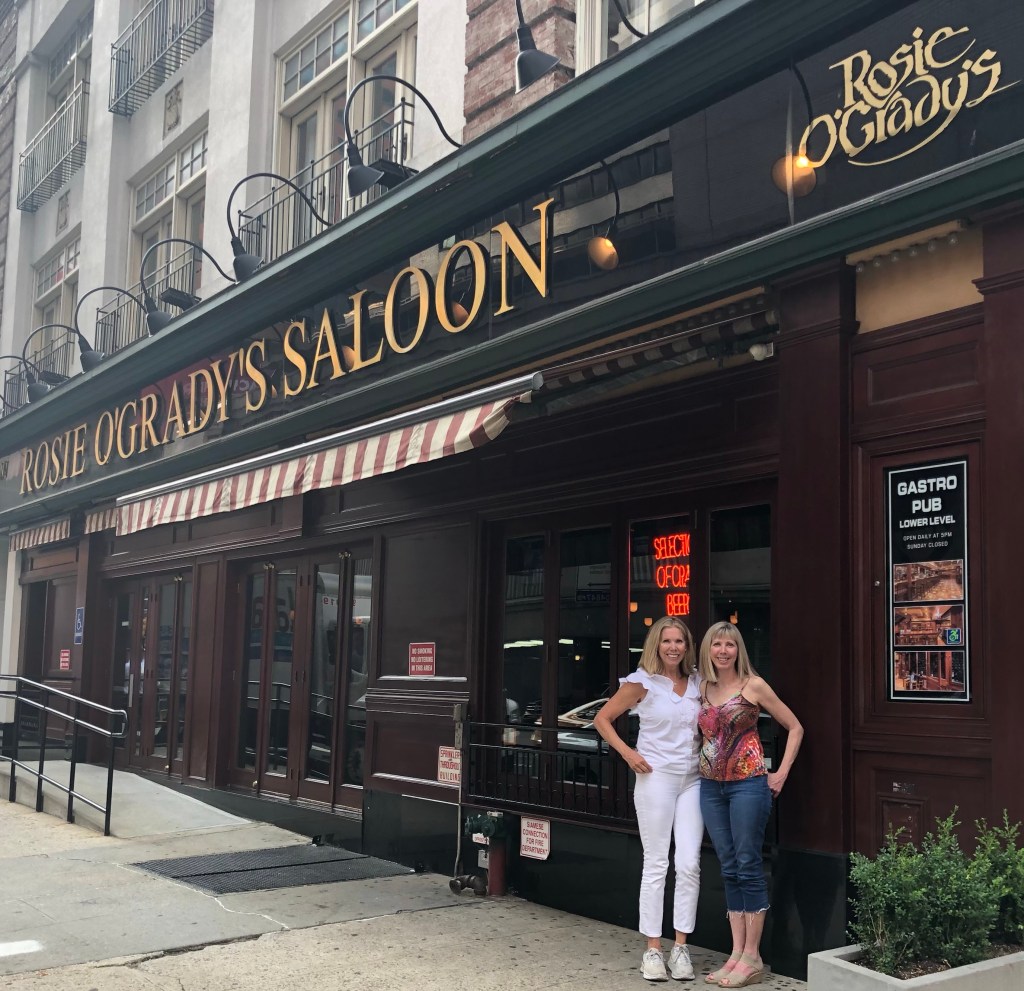
Sheila (left) and me outside Rosie’s almost 40 years later – minus the aprons…

The Resume

“I just need you to look it over for typos. I want to get it out as soon as possible.”

Lounging on my sister’s living room sofa, contentedly eating Hershey chocolate kisses from a small bowl, I leisurely leafed through a copy of Glamour magazine. It was a lazy Saturday morning with the most pressing matter in our young lives being which club we would visit that night – Heartbreak or, The Limelight?

I glanced over at my sister Anne, who sat pensively at her kitchen table, ballpoint pen in hand. A frequent visitor to her NYC apartment during summer and college breaks, I loved visiting my sister and was well aware of the coming and goings on in her life which at this moment, was updating her resume.

After working for several years caring for patients in a New York hospital’s Day Surgery unit, she was entertaining a foray into the corporate side of nursing. The job to which she was applying, involved working aside a prominent older scientist, a one Dr. Jonathan Mackey, assisting with medical research. Though she would miss bedside nursing, this new job would allow better hours and be less physically demanding.

Nestling into the depths of the cozy cushions, red marker in hand, I carefully proof-read the resume before me. Priding myself in both writing capability and creativity I was pleased to help my older sister who for my entire life, had looked after me. Several minutes later, I handed her back the sheet of paper containing just one simple addition I had scrawled under the category of “Interests.”

Studying the resume with a puzzled expression she looked up and remarked, “But I don’t play chess! Why would you add that?” “Trust me,” I replied. “It will set you apart from the average applicant. It shows you are a strategic thinker. Most chess players are highly intelligent!” My sister studied the resume once again, carefully entertaining the idea. She was of honest character and did not like to tell even a small white lie. “I don’t know Kathy…”

She called me the following week, her voice brimming with excitement “I have an interview for that job with the professor on Friday, 2PM! Wish me luck…”

My sister over the years, still tells the story, of the resume, generally at family gatherings or when someone is seeking a new job. And most often, after a glass of wine or two, when her resentment is at its lowest. It goes something like this.

Sitting in a small, nondescript office on that fateful Friday afternoon, my sister for the umpteenth, proofread her resume. She relaxed, feeling capable in her abilities. She smiled several times into the mirror of her makeup compact, having once read smiling to yourself, boosts confidence.

A distant whir of something that sounded like a motorized vehicle suddenly broke her concentration as Professor Jonathan Mackey glided into the room. A distinguished looking man, with a salt and pepper tinged head of hair, he wore an expression which conveyed a no-nonsense efficiency.

Holding my sister’s resume before him, he glanced up and down his eyes darting rapidly. Then suddenly, his facial expression changed, and appeared to soften, quite markedly. “Why Anne Marie!” he bellowed with a grin, “You and I seem to share a common vice…”

My sister’s heart beat rose ever so slightly. No, he couldn’t, he could not possibly mean…

“Chess!” Dr. Mackey added emphatically.

As my sister’s soul left her body, her mind raced for some sort of reasonable response. He continued, “To be honest, since I broke this damn ankle, I have been spending more time than I like to admit watching televised matches. I’ve been playing the magnificent game of Chess since my grand father first taught me, when I was only seven years old.”

The words “to be honest” hung thickly in the air…

She had two options, she told me and I knew at that moment, before she even uttered the words, that she had chosen the first.

“Well, I actually don’t play chess, Dr. Mackey,” she stammered. “My sister put it on my resume because….she thought it sounded good.” Silence followed for what seemed an eternity. Digesting my sister’s declaration of deceit, her potential future boss cleared this throat and re-positioned himself in the wheelchair. He then uttered just one phrase.

“You tell your sister, she would never get a job with me…”

Though she did not get the job, I am still welcome at my sister’s apartment. She has traded in New York’s East River, for the Hudson, and now resides in Tarrytown, New York. A rescue dog named Shorty, devoted to my sister, is the newest family member. The chocolate kisses still flow in abundance and Anne, has long forgiven me for the resume mishap.

Just last week, while visiting my sister for the weekend, we took Shorty for his evening walk. The sunset was particularly impressive and a cruise boat, chock full of New York tourists, could be seen in the distance slowly making its way up the Hudson. As we followed the path that wound along the river, I glanced at a small garden off to the right, directly ahead of us. Two older gentleman, seated at a small wooden table, sat opposite each other, deep in concentration. Playing chess.

And in that very moment through the grace of god or some other divine intervention, Shorty, spotting another dog approaching, jumped up abruptly. My sister, desperate to avoid a confrontation, yanked on the leash and quickly pivoted in the opposite direction.

I was saved.

A Mid-Summer’s Daydream

Arc de Triumphe, Paris France

Standing amid a sea of tourists on the teeming Boulevard Saint Germain, I watch as the sidewalk artist works his magic on my sister, who sits posed before him. We are in Paris for the weekend, the result of an incredible airfare originating from Dublin, where we are spending two weeks of the summer with our family. With only forty-eight hours to explore the city of lights, we make a solid vow to take in every sight and sound.

“The likeness is very good,” comes a voice from directly over my shoulder. Glancing behind me, I spot a wiry, young man, his hands jammed deep into his faded jean pockets. He stands aside the artist, studying the portrait with a fierce intensity. His accent appears to be French, and a wave of blonde hair falls over his forehead as he nods enthusiastically. “Yes, he captures her beauty quite well.”

A short while later, portrait in hand, which did bear an incredible likeness to my sister Anne, we stroll together with our new companion. Fabrice who speaks English fluently, is a twenty-something ice cream vendor who lives in a nearby suburb of Paris. He is in the city to meet his best friend and co-worker Danielle, for a work event that evening.

Perhaps we might like to join them for a cafe au lait?

I glance at my sister who steadily returns my gaze, her large, blue eyes reflecting a hint of disbelief. Fabrice, was gorgeous. And French. As we walk or rather float onward to meet Danielle at a neighborhood bistro which comes highly recommended by Fabrice, my mind tries to focus on the scenario before me. Pinching my arm sharply, it is confirmed. I am not dreaming.

Danielle, if possible, is even more handsome than Fabrice with one caveat; he does not speak English. Not a word. But we find it matters little. He smiles and nods amiably, with Fabrice as our translator. Our new french friends are fascinated to learn we live in NYC. Keen to visit having never been, they beg us for tales of the city. We sit at that sidewalk cafe for what seems hours. It is situated directly adjacent to the Eiffel Tower which at dusk becomes illuminated, in golden light.

As we ponder the best Parisian sites to visit the next day, Fabrice shakes his head. “Forget the tourist traps. Danielle and I will show you a different side of France.” He then proceeds to tell of a place, little known to tourists. A unique retreat, just an hour outside of Paris. They will take us if we are willing. And can pick us up at our hotel the next morning. 9 AM sharp.

Later that night, sipping a Keir Royal at our hotel bar, my sister and I ponder if our handsome French tour guides will in fact show up. We flip a coin allowing destiny to be the decider.

The weather the next morning is ideal for a day trip. Mild and brilliantly sunny. I sit in the passenger seat next to Fabrice who is driving. Anne and Danielle sit in the back. They are holding hands, proving the language barrier, non existent. Roaring down the autobahn that day, I can still feel the warm wind billowing through the open windows, and how it tasseled our hair in every direction.

Another memory. A soulful song that comes on the radio. Lenny Kravitz’s, 1980’s hit, “It ain’t over till it’s over.” Followed by Fabrice’s enthusiastic declaration of, “I love this song!” He sings along in abandon, a little off key, but his lilting French accent charms. To this day, every time I hear that song, I remember.

‘So many tears I’ve cried
So much pain inside
It ain’t over ’til it’s over’


Chateau de Chantilly is everything Fabrice and Danielle claim it to be, and more. A true sojourn from the bustling city, we walk along ancient stone walls, flowering gardens and a working stable. The serenity and beauty are unquestionable. A perfect destination for our last day in France.

After snapping several photos, my favorite of Fabrice at my prompting, sitting astride a large stone lion, I notice both he and Danielle, staring up the path at a nearby ice cream truck. Excusing themselves, they approach the truck, but instead of buying ice cream, circle it three times, staring at the vendor in a somewhat menacing manner. Upon their return they explain that the truck has infringed upon their territory and is not supposed to be there. I glance at my sister, worriedly anticipating a possible ice cream war but the scene dissolves with little fanfare as the ice cream truck drives hastily away.

As evening draws near, the four of us sit wordlessly in the grass. We watch as the huge French sun, glowing in muted tones of tangerine, slowly sets on the hillside. It is a fitting close to a perfect day; nature’s farewell to our weekend in Paris.

I take down the worn shoe box from the highest shelf of my bedroom closet. It sits most days undisturbed, often for long periods of time. It holds various letters from special friends throughout the years and a stack of photographs showcasing my life from youth, to present.

I remove one photo from the box.

It is old, faded. I study the image of a youthful Fabrice, who in present time would be around sixty years of age. He is sitting atop that stone lion at Chateau Chantilly, waving his arms and grinning wildly as he stares into my camera. I received a few postcards from him over the years, the last postmarked from the South of France where I imagine the ice cream trade lucrative and the vendors ubiquitous. I wonder where Danielle is now.

We wrote of reuniting some day. But it would never be.

For to meet once again would take away the sweetness of that mid-summer’s day in Paris so long, long ago…

In Search of Picasso

You didn’t say anything about a nude model!” my sister whispered to me, her hushed voice a mixture of both shock and delight. It was the very first night of Sculpting. , a Continuing Education course offered at the local high school, a stone’s throw from our Stuyvesant Town, NYC apartment.  I always loved the idea of learning something new and was certain a sculpting class would allow my long-time artistic aspirations, to at last become reality. And in only six weeks!

As the male sitting model, introduced by our teacher as “Roberto,” entered the classroom, a deafening silence filled the air. Clad in a beige, unassuming robe, he circled the packed room three times, then stopped abruptly front and center, his eyes flashing boldly. As if waiting a lifetime for this one moment of fame, he slowly untied the bathrobe and, in one flagrant and grandiose display, tossed it to the floor. Audible gasps filled the air, followed by scattered applause. My sister, clearly, was not the only one unprepared for a live show.

We soon became accustomed to the unclothed Roberto who greeted us each Wednesday night at 6PM with nothing more than a stony expression, a far cry from the theatrics of his first evening’s performance. During those two hours of class, which at times seemed endless, I kneaded and molded, kneaded and molded, my brow furrowed deep in concentration, in a futile attempt to give some semblance to the shape of a human torso.  But alas, after my third class I realized downtrodden, that sculpting rather than allowing joy and artistic expression, instead left me with a throbbing headache.

At the close of each class, we would gingerly place paper towels, soaked in warm water around our sculpture to keep it pliable for the following week, then retire it to the security of the classroom closet.  As I surveyed the work of the other student’s sculptures neatly lined up on the shelf, I felt a pang of envy. Every single one of them, even in their elementary stages of creation, exceeded mine in both talent and appearance. Arms that looked like arms and a head anatomically correct, resembling man, rather than beast.

On more than one occasion, entering that taunting closet before the start of class, I shamefully entertained the idea of “accidentally” taking one of the more attractive sculptures off the shelf and claiming it as my own.

To add fuel to the fire, my sister who always claimed she disliked art and had only joined the class “as a favor to me,” excelled in Sculpting and profusely thanked me for helping her discover this new found passion. “Why you are a natural!” lauded our teacher as she stood beside my sister’s desk one evening, admiring her work. Then glancing at mine with a grim expression, she nodded her head wordlessly and proceeded up the aisle.

At the end of our final class, I dejectedly stared at the object before me, six weeks in the making, its distorted arms reaching out to me, as if in solace. The teacher announced we could reclaim our piece the following afternoon, though I knew in my heart,  I would not return, opting rather to leave my sad sculpture and the memories of Sculpting class, tucked away in that closet forever.  

My sister, on the other hand, proudly positioned her prized sculpture in the foyer of her apartment. She awoke one morning, three months later, to find the arm broken off.  She swears her husband Kevin, who to this day vehemently denies the childish deed, the villain. A cruel payback after she was unable to accompany him to a cocktail party on the very same evening as her Sculpting Class, Section 2 was to begin.

As for me, I have just signed up for my next Continuing Ed Class, a course on Handwriting Analysis. Taking Pen to hand, rather than clay.

Picasso would no doubt, be pleased.

Nuns, Fists and Arithmetic

I can still hear the chant, more than fifty years later. The voices, which echoed from the concrete schoolyard three floors below my fourth grade classroom, began as a low murmur. A flat, monotone sound, lacking any emotion whatsoever.  Three simple letters were repeated by the bystanders as they stood crowded around the two entrants of this midday melee, their origin or meaning to this day unknown. Though their affect for some odd reason, a perfect accompaniment to the event taking place.  And it sounded something like this, if a thing like that, could even be described:  “A- A- A.”  A two second pause between each shout of “A” was followed by a rhythmic clap.

These school yard fist fights, generally occurring no more than a few times a year, never excelled to more than a few punches being thrown, in the short time allowed before being broken up by a teacher. Egos bruised, more than body. Nonetheless they were a diversion and a welcome highlight on a non eventful day at St. Mary’s elementary school.

As my classmates and I scrambled out of our desks and raced to the window in the attempt to better identify the fighters, (generally boys from the fifth or sixth grade) our teacher, Sister Mary Alice, a tall, lanky bespectacled nun with a baritone voice, screamed for order. As she raced from the classroom, desperate to break up the cacophony below and bring the culprits to justice, her black habit flew boldly behind her, resembling some strange super-hero or large prehistoric bird.

With each passing moment, the chant increased in both speed and tone, finally reaching its crescendo; now, a frenzied roar, “AAAAAAAAA!!!!” Cheers and applause followed, signifying a winner was at hand, neither boy, no worse for the wear.

We remained at the window, my classmates and I, as the crowd dispersed. Below, Sister Mary Alice authoritatively attended to the boys, tucking in shirts and collecting a lone pair of eyeglasses that lay dejectedly on the school yard, having flown off during the match.  Making our way back to our desks, we opened our text books to the long division that lay before us, anxiously awaiting our nun’s return. She would no doubt be in a fury and we all secretly knew, to be on our best behavior or we would surely live to regret it. Though some bold prankster, fueled by the excitement, had drawn a sketch of Sister Mary Alice, in a pair of boxing gloves, on the classroom chalk board.

We returned to our long division, the school yard now silent below. Peter Foley, his shoulders hunched, painstakingly wrote, 100 times on the chalkboard, “Use words not fists.” Sister Mary Alice sat silently, in the corner of the classroom deep in concentration, her brow furrowed, sewing up a small tear in her habit.

All was well again at St. Mary’s.